

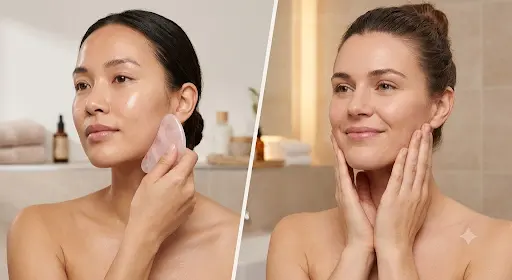
Facial lymphatic drainage went from “weird thing estheticians do” to a full-blown skincare category in about three years. Everyone’s depuffing. Everyone’s contouring. And every comment section I’ve seen on this topic eventually turns into the same fight: stone tool or bare hands? I’ve tested both on hundreds of client faces over the years, and here’s the honest answer — it depends less on the tool and more on your skin that particular morning.
Both methods push stagnant fluid toward your lymph nodes. That part’s not in dispute. Where they split is precision, cost, and how much feedback you actually get from your own skin while you’re doing it.
The Real Difference, Side by Side
| Feature | Gua Sha Tool | Hands-Only Massage |
| Primary Advantage | Sharp edge precision, deep contouring | You just… feel it, no learning curve |
| Ideal For | Jawline sculpting, stubborn jaw tension | Sensitive skin, quick morning depuff |
| Required Slip | High — skip the oil and you’ll regret it | Moderate — a serum usually does the trick |
A rose quartz face massage edge can get into the hollow under your cheekbone in a way four fingers just can’t. But I’ve also watched people white-knuckle a gua sha tool and scrape themselves raw because they skipped the oil step. Hands forgive mistakes. Stone doesn’t.
Best Practices (Don’t Skip These)
Prep with slip, always. Dry skin plus any tool equals micro-tears. I’ve seen this happen to actual estheticians who should’ve known better. Oil or serum, no exceptions.
Featherlight pressure. Your lymphatic vessels sit just under the surface barely a millimeter down in some spots. Pressing hard doesn’t move fluid faster. It just bruises you and makes you look worse the next day.
Clear the neck first. Sweep down the sides of your neck to the collarbone before you touch your face. Skip this and you’re pushing fluid into pathways that are already backed up. Waste of ten minutes.
Mistakes You Make Which Undo Your Efforts
It’s not about whether you use tools or not, but I keep noticing that people make the same three mistakes over and over again. Moving up instead of down, from neck to the collar bone, which goes against the flow of the lymph drainage process. Using circular motions instead of long strokes in one direction, which only relocates the puffiness instead of draining it. And applying the technique to an unprepared, product-free face when you are in a hurry, hence resulting in redness that persists all day.
Quick-Start Routine
- Cleanse face and hands. Actually wash your hands people skip this constantly.
- Apply 4–6 drops of a non-comedogenic facial oil.
- Open the neck pathways first, sweeping downward toward the collarbone.
- Work outward from center-face toward the ears.
- Rinse your stone tool with warm water and gentle soap after every single use.
What I’ve Actually Learned Doing This
- Gua sha wins on structure, not on comfort. If your goal is a sharper jawline or you carry tension in your masseter muscles from clenching (most of us do, thanks to stress and screens), the tool’s edge finds spots where your fingertips glide right past. It’s not gentle. It’s not supposed to be — that’s the trade-off for the contouring effect people chase.
- Hands win on days your face just feels off. Breakout brewing, skin barrier compromised, or you’re two minutes from walking out the door — hands are forgiving, warm, and require zero cleanup. No bruising risk. No hard edge catching on a blemish you didn’t notice yet. Honestly, most people would get better long-term results just doing hands-only consistently than doing gua sha sporadically and inconsistently.
Forget what the trends are saying and figure out what your skin wants today. Stress lines around the mouth, defined cheekbones, tough skin that can stand some manipulation – grab the tool. Rosy skin, new breakouts, sensitivity, or you are pressed for time – use only your hands. Those who have the best results are not necessarily sticking to one treatment or another. They are simply truthful about what their skin can tolerate that day.
The Real Takeaway
Gua sha chisels. It releases that deep, stubborn tightness along the jaw and brow that fingers alone rarely touch. Hands-only is safer, warmer, faster — no bruising, no tool to sanitize, no learning curve. Do both, honestly. Alternate them. That’s where the actual long-term contouring results show up, not from picking one side forever.
Where This Is Heading
Skincare’s going hybrid. Obsidian and stainless-steel tools are already getting paired with microcurrent devices, blending old-school manual therapy with the toning tech that used to live only in med-spas. Give it two years and I’d bet the face massage “tool vs. hands” debate looks quaint.
FAQ
Can I do this every day? Yes. Gentle daily practice — hand or tool, doesn’t matter much — keeps fluid from pooling and keeps your skin looking less puffy by mid-morning.
Which is safer for acne-prone skin? Hands, no contest. You can feel where a breakout is and steer around it instantly. A hard edge doesn’t give you that same real-time feedback, and dragging a tool over active blemishes risks spreading bacteria you really don’t want spread.