

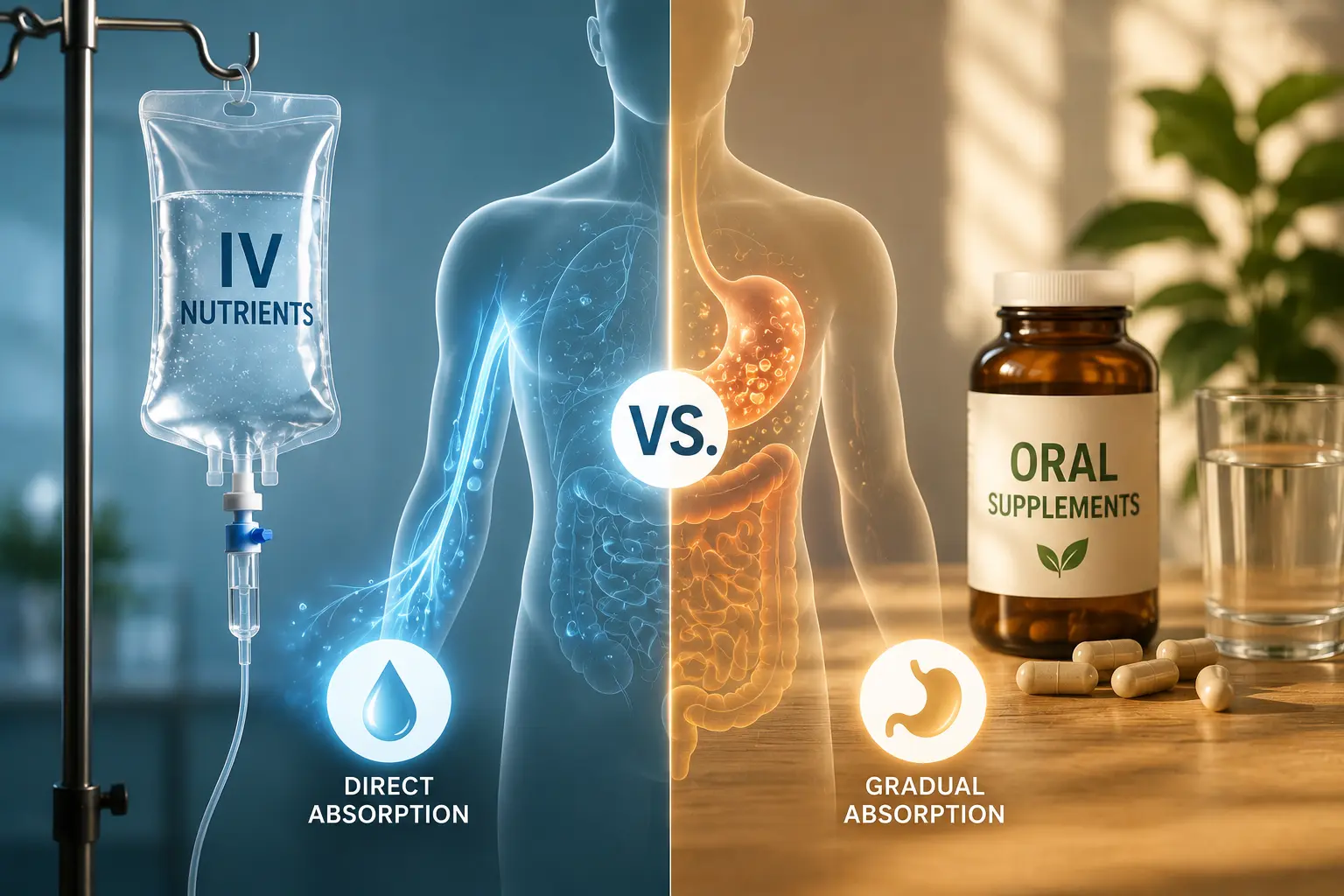
Walk down any supplement aisle and the promise is the same: take this daily and your levels will improve. For plenty of people that works fine. For others, the bottle empties month after month and the fatigue, the low labs, or the sluggish recovery never really shift. The usual explanation involves the word absorption, which gets used loosely enough to lose meaning. It is worth unpacking, because it is the actual reason intravenous nutrient therapy exists.
Bioavailability, in plain terms
Bioavailability describes how much of what you swallow ends up circulating in your bloodstream where your body can use it. It is almost never one hundred percent. A capsule has to survive stomach acid, get broken down, cross the intestinal wall, and pass through the liver before anything reaches circulation. Each step costs you a percentage. For some nutrients the loss is modest. For others it is substantial, and the body actively caps how much it will take in at once regardless of how large the dose on the label is.
Why an IV changes the math
An infusion skips the digestive tract entirely and delivers nutrients straight into the bloodstream. That does two things. It removes the absorption ceiling that the gut imposes, and it makes blood concentrations far more predictable. Vitamin C is the clearest illustration. Oral doses plateau because intestinal transport saturates, which means taking more does not meaningfully raise blood levels past a certain point. Given intravenously, concentrations reach ranges that oral dosing simply cannot produce. Whether a higher concentration is useful depends entirely on the situation, and that is a clinical judgment, not a marketing claim.
Who tends to notice the difference
For a generally healthy person eating reasonably well, oral supplements are usually adequate and considerably cheaper. The people who tend to notice a difference are those whose gut is not cooperating. That includes people with inflammatory bowel conditions, celiac disease, or a history of gastrointestinal surgery, where the absorptive surface itself is compromised. It also includes people dealing with chronic illness, prolonged fatigue, or recovery from a demanding illness, where intake is poor and demand is high at the same time. Dehydration is its own case, since fluid volume responds to an infusion in a way that sipping water over hours does not.
What absorption does not solve
Delivery is only half of the equation. Getting a nutrient into the bloodstream does not guarantee your cells use it well, and it does not address why levels were low to begin with. Poor sleep, unmanaged inflammation, medication effects, and undiagnosed conditions all sit upstream of a lab value. This is why serious providers test rather than assume. It is also why infusions are best understood as supportive care that works alongside a broader plan, not as a substitute for figuring out the underlying cause or for the medical treatment you are already receiving.
What good practice looks like
Higher delivery means dosing deserves more care, not less. Look for a provider who reviews your medications, asks about kidney function and relevant conditions before recommending higher-dose protocols, and orders labs rather than working from a menu. Expect honest framing: supports, may help, part of your plan. A provider willing to tell you that you are not a good candidate for something is demonstrating exactly the judgment you want. Anyone promising outcomes has left clinical territory.
Deciding whether it is worth it
The practical question is not whether an IV absorbs better than a pill, because it does. It is whether your particular gap is an absorption problem at all. If you have taken supplements consistently and your labs or your symptoms have not moved, that is a reasonable conversation to have with a provider who can test and interpret rather than sell. For people in the Owasso area exploring that route, IV therapy in Owasso is available with medical oversight and lab-guided protocols for the more advanced options.
The bottom line
Absorption is a real limitation and intravenous delivery is a real way around it. That does not make infusions the answer to everything. Used thoughtfully, with testing behind the decision and a provider who is candid about limits, they can be a genuinely useful form of support. Used as a shortcut around questions nobody has asked yet, they are an expensive way to skip the diagnosis.