

You know the smell. You open a new wardrobe, open the drawers, and smell a sharp, slightly sweet chemical smell. The majority frown their noses and refer to it as the new furniture smell, and continue to hang clothes up.
The name of that smell is formaldehyde.
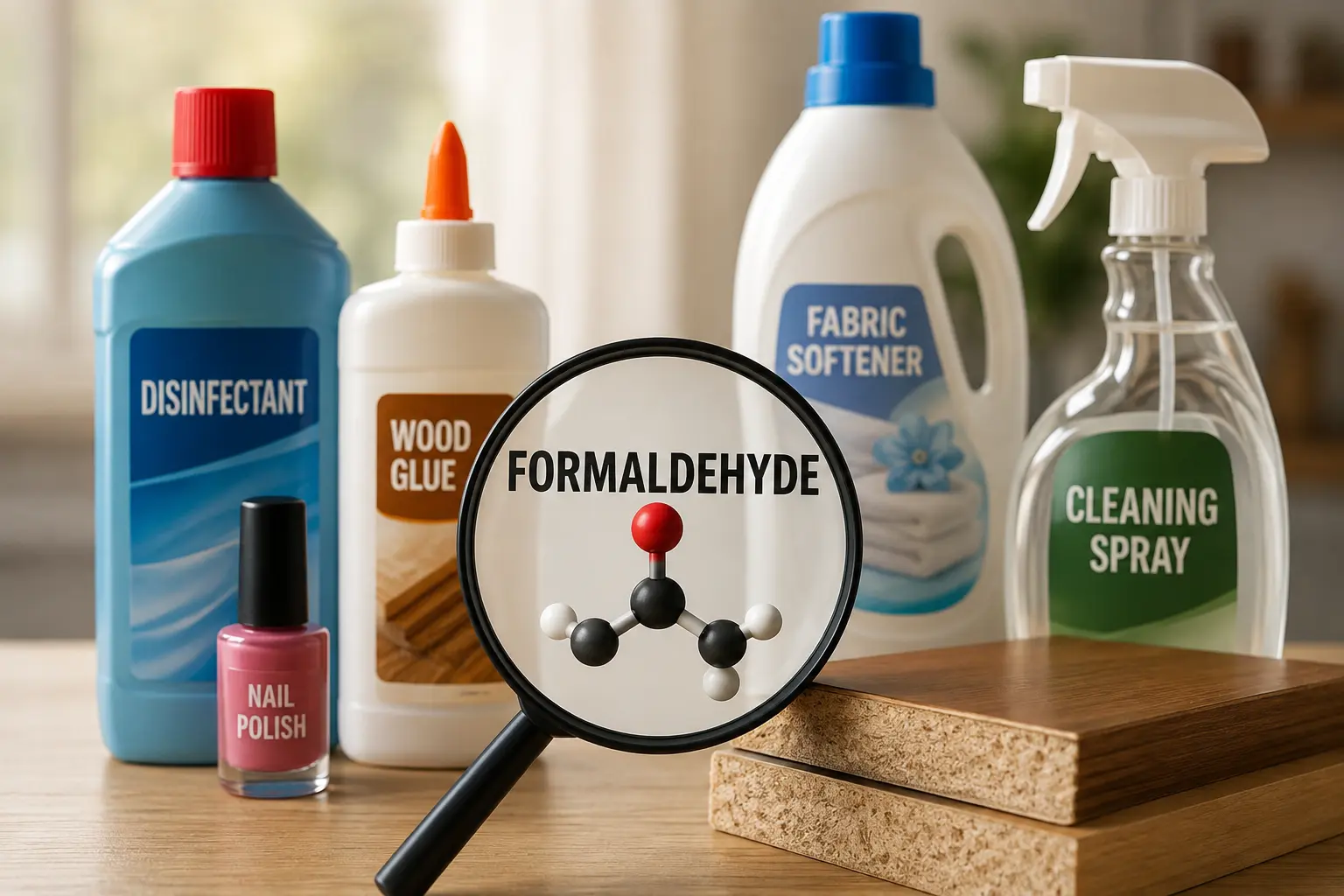
This is what astonishes, it is not only the wardrobe. Go through your apartment, and you pass by a dozen objects emitting the same gas. The kitchen cabinets. The laminate floor. The blackout curtains. The sink disinfectant.
The list of household products with formaldehyde that Singapore homes contain is far longer than most owners expect, and almost none of it is labelled in a way that makes this obvious.
All this does not imply that your home is unsafe. Normal indoor air has low-level formaldehyde. However, concentrations are dependent on what you have and the ventilation of your place, and in a small, air-conditioned apartment in a hot climate, the two variables do not go well.
In this article, you are taken through your home room by room, showing the source of the gas. Reducing them is no longer guesswork once you are able to see the sources.
Why Formaldehyde Ends Up in Everyday Items
The choice of formaldehyde is due to its low price, stability, and multitasking.
Urea-formaldehyde resin is used as a binder to bond wood particles into flat panels, which is much cheaper than solid timber. It provides fabrics with crease resistance and enhances their durability as a finish. As a preservative, some compounds emit minute portions to prevent the growth of bacteria in the shampoos and cleaners.
In both instances, the chemical remains in the product and evaporates gradually, a process known as off-gassing. It is heat- and moisture-driven, so the climate here, the tropical climate, is important: the same cabinet produces much more heat and moisture here.
Engineered Wood: The Biggest Source in Most Homes
Fix this category in case you fix only one category. Carpentry, rather than the cleaning cupboard, is the biggest source of indoor formaldehyde Singapore residents live with.
Plywood
Plywood is resin-bonded thin layers of wood. Interior grade sheets are made with urea-formaldehyde adhesive that emits more than the phenol-formaldehyde resin in exterior grade boards. Find it in cabinet carcasses, false ceilings, and sofa frames.
MDF and Particleboard
MDF is thick, smooth, and glues well. It contains a greater resin load (gram-per-gram) than plywood, and is one of the most important products containing formaldehyde in a furnished house. Flat-pack shelving predominantly uses particleboard.
Laminate and Veneer
This fact modifies what you request from your contractor. The panel face is covered by a laminate layer that delays emissions. The issue is the edges.
Uncoated edges or freshly trimmed edges release much more gas, as the core is covered with resin. This is why site-cut carpentry produces more waste than factory-sealed units, and why edge-banded panels should be asked for after.
Flooring
All types of laminate flooring, engineered timber, and underlay are based on adhesives. The per square metre cost is relatively low; the problem is size. Flooring occupies more area than any other substance, and therefore a few across ninety square metres will be counted quickly.
Going Room by Room
Living Room
The largest space, and the best ventilated, is on your side. Contributors include sofas, plywood-framed TV consoles, bookshelves, feature walls, and crease-resistant curtains. This is supplemented with fresh paint or varnish in a few weeks.
Bedroom
The most important thing in this case is exposure: you have a closed room with the air-conditioning system circulating the same air eight hours a night.
The usual suspects are wardrobes, bed frames, mattresses, wrinkle-free bedsheets, and blackout curtains. One thing you can change is to keep the door open at night.
Kitchen
The most predominant source is the cabinets. Kitchen carcasses are virtually all engineered wood, and since they remain closed, the air inside them contains much higher concentrations than the room. Close a cupboard and leave it open for a week, and you can smell it. Countertop adhesive and backsplash glue add smaller amounts.
Bathroom and Laundry
Vanity units are housed in the hottest and most humid room, and both variables hasten the release. Here, cleaning products are no exception, as disinfectants, fabric softeners, and even some detergents have preservatives that emit formaldehyde gradually.
Study and Storage
The abandoned areas, the frequent culprits on a square metre. Flat-pack desks, filing units, and shoe cabinets consist of almost pure particleboard.
A storeroom that is always closed is similar to a closed box. Degrees within are elevated, and whenever you open it, that air travels into the flat.
The Sources People Rarely Think About
Other than carpentry, various everyday Singapore home products have smaller yet significant contributions.
Textiles and clothing. Wrinkle-resistant and permanent-press finishes are based on formaldehyde resins. Prior to the use of new clothing, bedding, and curtains, a significant portion is washed.
Cleaning products and personal care items. Some preservatives are slow-release formaldehyde donors, and these will appear as DMDM hydantoin, quaternium-15, imidazolidinyl urea, or bronopol on the label. These are legal and applied in small amounts, although it is worth noting that in case you have sensitive skin or airways.
Adhesives and DIY supplies. Contact cement, wood glue, and certain sealants also contain solvents and formaldehyde during the curing process.
Paint and coatings. Compared to solvent-based lacquer, wood stain, and varnish, water-based paints do not emit much.
Why Singapore Homes Are Affected More
Two local factors change the maths.
The former is climate. The rates of emission increase drastically with temperature and humidity. The cabinet at 31 degrees discharges way more than at 20, and when the humidity is high, the resin deteriorates faster.
The second is our way of life. Windows remain closed, air-conditioning does not replace air, but recycles, and layout designs are tight. An average HDB home or modern condo interior Singapore developers deliver packs with the same weight but less air volume.
To provide context, the NEA guideline on office premises in Singapore has formaldehyde at 0.1 parts per million within eight hours. Units that have been recently furnished are often higher than during the initial weeks.
How to Shop Smarter
You must not avoid formaldehyde, and you need not. At purchase costs, it costs much less to reduce the load than to remedy it afterward.
- Request E0 or E1 grade boards. E0 produces less than E1, and they both beat uncertified panels.
- See the Singapore Green Label or SGBC certification on the furniture and finishes.
- Select solid wood or metal on large pieces where it is economical.
- Use water- or low-VOC adhesives and paints instead of solvent-based products.
- Ask for factory-sealed with edge-banded panels instead of site-trimmed panels.
- Purchase display items where feasible. They have been off-gassing for months.
Reducing Formaldehyde Exposure in Singapore Homes Already Has
Even when you already have your furniture installed, these steps do make a difference.
Ventilate daily. Fifteen minutes of open windows in the morning is as effective as any gadget and costs nothing.
Open enclosed spaces. Open wardrobes, drawers, and storeroom doors several hours per week. The air contained within is much more concentrated than the room air.
Run heat cycles in a new unit. Close it, and allow it to heat for several hours, then open it and empty it. Do it every week in the first month.
Activated carbon, not HEPA only. HEPA filters trap dust and mold spores but not gases. Carbon media does, and you must have a good amount.
Wash new fabrics. The first wash of bedding and clothing gives off most of the finish.
Control humidity. Maintaining indoor humidity levels of between 50 and 60 percent minimizes emissions and prevents the growth of molds.
When to Call a Professional
Ventilation is sufficient in most households. Professional formaldehyde removal in Singapore should be considered when eye irritation, sore throat, headaches, or fatigue continue after three months, when an infant or an asthmatic resides in the home, or when you have just changed residence after a renovation.
The testing ought to be done before treatment by a credible provider, with calibrated equipment instead of colour-change strips, and a written before-and-after report issued. Watch out for those who claim to remove permanently on a single visit.
Frequently Asked Questions About Formaldehyde
Is all solid wood furniture free of formaldehyde?
Not entirely. The timber also produces insignificant volumes, but stains, varnishes, and adhesives used in joining are also contributors. Solid wood is better, but not a guarantee.
Will formaldehyde be eliminated using air purifiers?
Only activated carbon in large amounts or catalytic media. HEPA-only units trap particles and do not treat gases, notwithstanding the marketing.
Should I dispose of furniture that produces formaldehyde?
Rarely necessary. The initial months reduce the emissions drastically, and the majority of them are dealt with by ventilation. Only consider replacement in the case of persistent symptoms and with confirmation of high levels by testing.
Do the indoor plants work?
In the laboratory, modest absorption is observed under controlled conditions, but the effect in a real room is insignificant. Keep the plants not because of the air, but because it is good.
Conclusion
The main formaldehyde sources at home are not exotic or hidden. The cabinets, flooring, and soft furnishings you already have, plus cleaning products and textiles on top.
It is good news, as common sources react to common solutions. Ventilate consistently. Open your carpentry. Wash new fabrics. Use a carbon filter instead of a HEPA. And in renovating, demand certified low-emission materials.
Do so, and the indoor air quality Singapore families live with is getting better and better without panicking, costly devices, or even disposing of furniture that is not causing any trouble.