

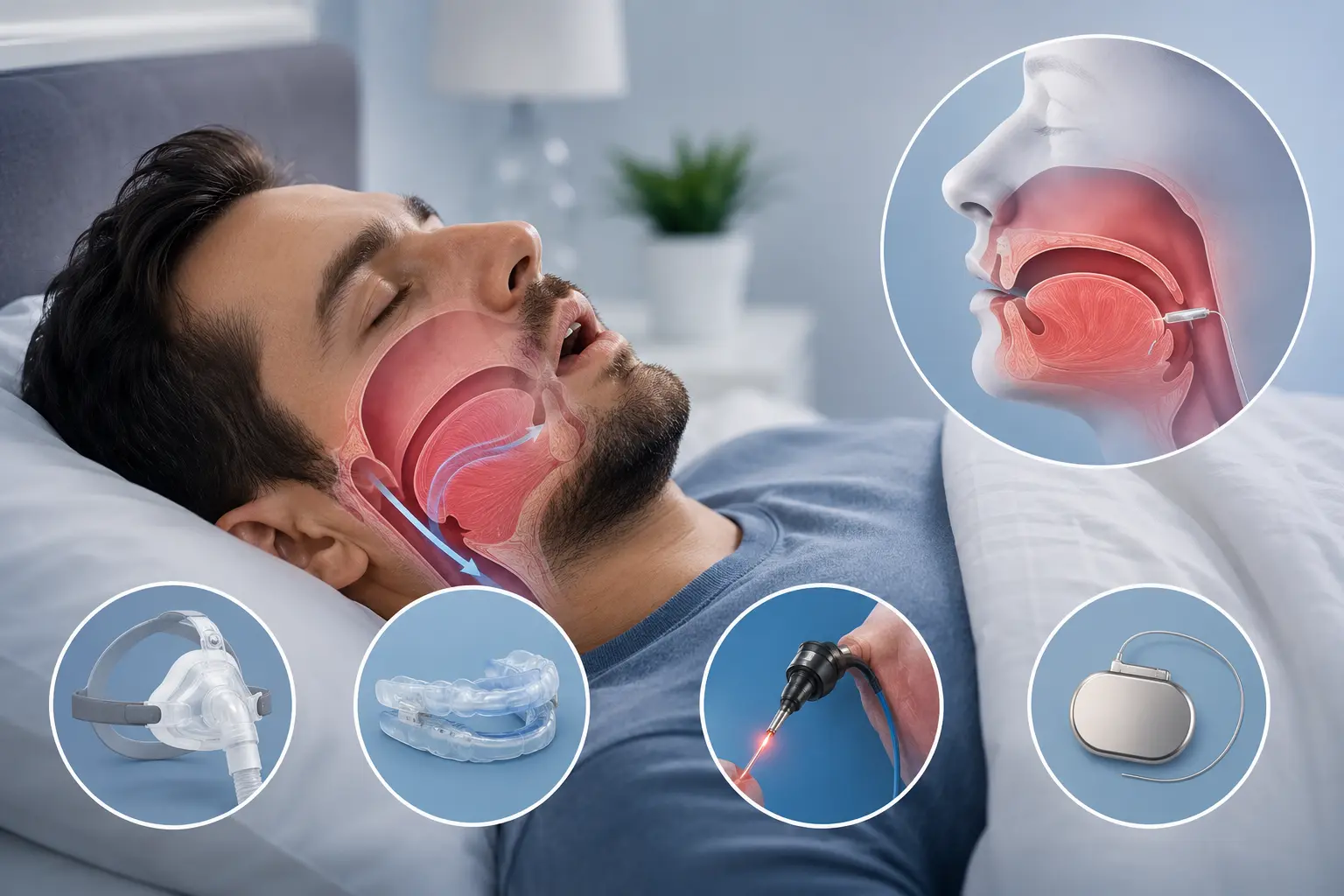
Obstructive sleep apnea (OSA) is a sleep-related breathing disorder where the upper airway becomes narrowed or blocked during sleep. This can cause repeated pauses in breathing, loud snoring, disrupted sleep and daytime symptoms such as fatigue or poor concentration.
ENT specialists play an important role in evaluating the upper airway to identify areas that may contribute to obstruction. Since airway blockage can happen in different areas, treatment is usually based on the patient’s symptoms, sleep study results, anatomy and overall health.
What Causes Obstructive Sleep Apnea?
During sleep, the muscles around the throat naturally relax. In some people, the airway becomes too narrow or collapses, making it difficult for air to flow normally.
Possible factors contributing to OSA include:
- Enlarged tonsils
- Enlarged adenoids in children
- Nasal blockage
- Deviated nasal septum
- Nasal polyps
- Enlarged tongue base
- Soft palate obstruction
- Jaw structure
- Excess tissue around the airway
- Weight-related airway narrowing
An ENT specialist assesses where the obstruction occurs before recommending treatment.
Why See an ENT Specialist for Sleep Apnea?
An ENT specialist can evaluate physical structures that may contribute to sleep apnea.
Assessment may include:
- Medical history review
- Snoring and sleep symptom assessment
- Nose and throat examination
- Nasal endoscopy
- Review of sleep study results
- Airway evaluation
- Assessment of tonsils, tongue base and palate
Understanding the location of airway blockage helps guide treatment planning.
1. Nasal Treatment for Obstructive Sleep Apnea
Nasal blockage can affect breathing during sleep and may contribute to snoring or sleep discomfort.
ENT treatment may focus on improving nasal airflow through:
- Allergy management
- Nasal sprays
- Treatment of chronic inflammation
- Nasal polyp management
- Septoplasty for deviated septum
- Turbinate reduction in selected cases
Nasal treatment may be useful for patients with significant nasal obstruction, although it may not completely treat sleep apnea when blockage occurs elsewhere in the airway.
2. CPAP Therapy Support and Assessment
Continuous positive airway pressure (CPAP) is commonly used for obstructive sleep apnea. It delivers pressurised air through a mask to help keep the airway open during sleep.
ENT specialists may assess whether airway problems are contributing to:
- CPAP difficulty
- Nasal discomfort
- Mouth breathing
- Poor mask tolerance
Treating nasal obstruction may help some patients use CPAP more comfortably.
3. Oral Appliance Therapy
Some patients with mild to moderate OSA may discuss oral appliance therapy. These devices reposition the jaw or tongue to help maintain airway space during sleep.
ENT assessment may help determine whether the airway anatomy is suitable for this approach.
Patients may ask:
- Is my sleep apnea severity suitable for an oral appliance?
- Is my airway obstruction mainly nasal or throat-related?
- Should I see a dental sleep specialist?
4. Tonsil Surgery
Enlarged tonsils can narrow the airway, especially in children but also in selected adults.
Tonsil surgery may be considered when:
- Enlarged tonsils contribute to airway obstruction
- Snoring is significant
- Sleep apnea is linked to tonsil enlargement
- Recurrent tonsil problems occur
The decision depends on symptoms, examination findings and sleep study results where available.
5. Adenoid Surgery in Children
In children, enlarged adenoids may contribute to mouth breathing, snoring, nasal blockage and sleep-disordered breathing.
Adenoidectomy may be considered when enlarged adenoids contribute to:
- Persistent nasal blockage
- Sleep apnea symptoms
- Snoring
- Recurrent ear problems
- Breathing difficulties during sleep
Children with regular snoring or restless sleep should be assessed if symptoms affect sleep quality or daytime behaviour.
6. Palate and Throat Procedures
Some patients have airway obstruction involving the soft palate or throat tissues. ENT procedures may be considered depending on the site and severity of obstruction.
Possible procedures may include:
- Palate procedures
- Throat tissue modification
- Uvulopalatopharyngoplasty (UPPP)
- Other airway procedures
These options are usually considered after careful assessment.
7. Tongue Base Procedures
For some patients, obstruction occurs lower in the airway near the tongue base. ENT specialists may assess whether this area contributes to sleep apnea.
Possible treatment options may include selected tongue base procedures or other airway-focused treatments.
Suitability depends on:
- Sleep study results
- Airway anatomy
- Severity of OSA
- Previous treatment response
8. Sleep Apnea Surgery
Surgery may be considered for selected patients when:
- There is a clear anatomical cause of obstruction
- CPAP is not tolerated
- Other treatments are unsuitable
- Airway assessment identifies a treatable obstruction point
Possible surgical approaches depend on where the airway collapses.
Before surgery, patients should discuss:
- Expected benefits
- Limitations
- Risks
- Recovery period
- Alternative treatments
9. Weight Management and Lifestyle Support
Lifestyle changes may support sleep apnea management, especially when weight contributes to airway narrowing.
Patients may discuss:
- Healthy weight management
- Sleep position
- Alcohol reduction
- Smoking cessation
- Regular physical activity
- Sleep routine
Lifestyle changes may be used alongside other treatments.
How ENT Specialists Decide on Treatment
Treatment decisions depend on several factors, including:
- Sleep study findings
- Severity of OSA
- Patient symptoms
- Airway anatomy
- Nasal blockage
- Tonsil size
- Tongue position
- Weight and overall health
- CPAP experience
- Patient preferences
There is no single treatment that suits every patient.
When Should You Seek ENT Assessment for OSA?
Consider seeing an ENT specialist if you experience:
- Loud regular snoring
- Breathing pauses during sleep
- Waking up choking or gasping
- Daytime sleepiness
- Morning headaches
- Poor concentration
- Difficulty using CPAP
- Persistent nasal blockage
- Snoring affecting your quality of life
A sleep study may be recommended before deciding on treatment.
ENT treatment options for obstructive sleep apnea depend on where airway obstruction occurs, the severity of the condition and the patient’s overall health. Options may include nasal treatment, CPAP support, oral appliances, tonsil or adenoid procedures, airway surgery and lifestyle changes.
A thorough assessment helps identify the cause of airway blockage and determine which treatments may be suitable. Patients with loud snoring, breathing pauses, daytime tiredness or difficulty using CPAP should consider seeking specialist advice.
This article is for general information only and should not replace medical advice from a qualified healthcare professional.