

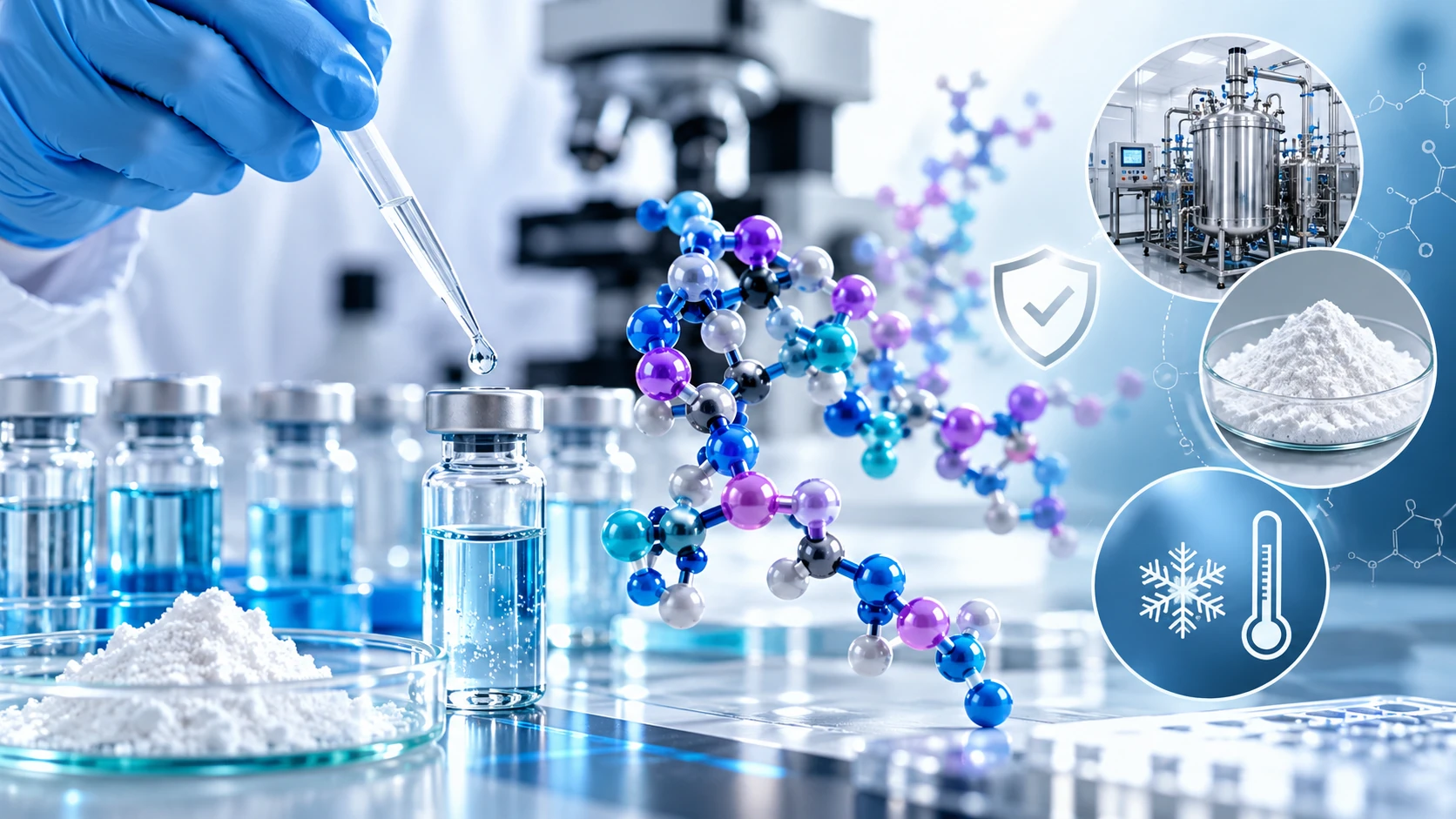
Synthetic Peptides are peptides that are produced using a chemical method.The synthetic peptides are peptides produced by a chemical method.
Synthetic peptides are vital to scientific studies, biotechnology, drug development, and laboratory uses. These small protein sequences are engineered to have a particular biological activity or role, or to be used as tools to study complex physiological processes. Their use depends on more than their intended sequence, though. The quality and reliability of a peptide is dependent on manufacturing techniques, levels of purity and stability.
These all detail aspects which can help researchers in their selection of peptides for lab activities. This ranges from synthesis methods to quality assurance and correct storage ensuring product consistency and successful research results.
What Are Synthetic Peptides?
Molecules composed of amino acids linked by peptide bonds are called peptides. They typically are smaller than proteins, though this isn’t always defined by a set size limit. The peptides in living organisms are involved in various biological processes, such as cell signaling, hormone regulation, and cell-to-cell communication.
Synthetic peptides are peptides that are manufactured in a lab rather than extracted from a biological source. This method enables researchers to define an amino acid sequence and create a molecule with a specific aim in mind.
Synthetic production also provides more consistency and control of composition. Depending on its use, the researchers might need a particular sequence, chemical modification or degree of purity. Cautious manufacturing and analytical testing are vital due to these requirements.
How Are Synthetic Peptides Manufactured?
There are several different manufacturing methods available, but one of the most common is solid-phase peptide synthesis (SPPS) which allows the manufacture of a custom peptide.
Solid-Phase Peptide Synthesis
The first amino acid is fixed to a solid support in SPPS. These additional amino acids are then introduced one by one in a controlled manner by chemical reactions. Typically, each cycle includes removing an amino acid protecting group, adding the next amino acid, and rinsing off any unwanted reagents or by-products.
After the sequence is synthesized, the peptide is released from the support and deprotected. The resulting material can then be further purified and analyzed.
SPPS is flexible and allows for many custom sequences to be made feasible. But longer reactions and challenging combinations of amino acids may lead to less than complete reactions and unexpected by-products.
Liquid-Phase Synthesis
Peptide synthesis using the liquid phase is performed in solution. It may be beneficial for the synthesis of shorter peptides or for the synthesis of some peptide fragments that can be subsequently joined together.
While it can be useful under certain production conditions, purification and reaction monitoring could be difficult as the number of synthetic steps is increased. Thus, manufacturers choose the methods based on the structure of peptide, the production parameters, and the purpose of the peptide.
Why Peptide Purity Matters
Peptide purity is the percentage of the peptide in a sample compared to its contamination by other peptides that can be detected. These can be incomplete sequences, deletion products, unwanted chemicals used in the manufacturing process, or impurities similar to them.
The high purity is a necessity as contaminants can have a negative impact on the experimental results, or on the measurements taken, or can add uncertainty to the research findings. However, having a high purity percentage does not mean that a peptide is good for all applications.
Generally, high performance liquid chromatography (HPLC) is used to evaluate peptide purity thus separating the peptide components present in a sample. Mass spectrometry may be useful to confirm the molecular mass and can aid in determining the identity of the desired product. For certain applications further testing could be required to measure the water content, presence of residual solvents, counterions or other qualities.
Existing analytical documentation, such as chromatograms and mass spectrometry data (if available) should be examined by researchers. They also should be able to differentiate between purity and identification and overall quality as these are interrelated but distinct.
Factors influencing peptide stability include:The factors that influence peptide stability are:
Stability is the property of a peptide to maintain its chemical structure and property(s) with respect to a standard period of time. Even if the peptide is manufactured well, it might be broken if it comes in contact with the wrong environment.
One of the factors to consider is temperature. Some formulations may be affected by improper freezing and thawing procedures and chemical degradation can be hastened by heat. Moisture may also be a factor of degradation, especially if a peptide is stored in a moisture absorbing form.
Other factors are light, pH, oxygen and the amino acid sequence of the peptide. Some sequences tend to oxidize, hydrolyse or aggregate more easily than others. Thus, no single storage condition is guaranteed to be suitable for all peptides.
Product specific storage instructions should be followed and stability data taken into account by the researcher. They should take into account solvent compatibility, concentration, container suitability and use time when preparing solutions. Stability should not be assumed from appearance; it needs to be established through the appropriate testing.
Using Reliable Synthetic Peptides for Research
Peptide selection is more than price and advertised purity. The sequence, manufacturing method, analysis techniques, documentation and applicability for the targeted lab use should be taken into account.
A supplier should supply all product information and, if possible, a Certificate of Analysis or analytical data supporting the information. When using suppliers like Gene Peptides for research, researchers are encouraged to review the documentation and validate the products that are being supplied to ensure they are suitable for their research needs.
It is also worth noting that the research-use products are not necessarily approved for human consumption or medical use. Their use should comply with regulations, institutional requirements and appropriate safety laboratory procedures.
Conclusion
Synthetic peptides have been provided by scientists with precise tools for investigation of biological systems, however their reliability depends on careful production techniques and useful standards for purity and suitable stability control. Knowledge of the synthesis methods will help to understand the possible sources of impurities and analytical testing is used for identity and evaluation of quality. Proper storage is also used to help make sure that the material has the properties intended.
These factors, viewed in concert, and with attention to clear documentation, will enable researchers to make more informed decisions, to be more consistent in their experiments, and to be more confident of their lab results.