

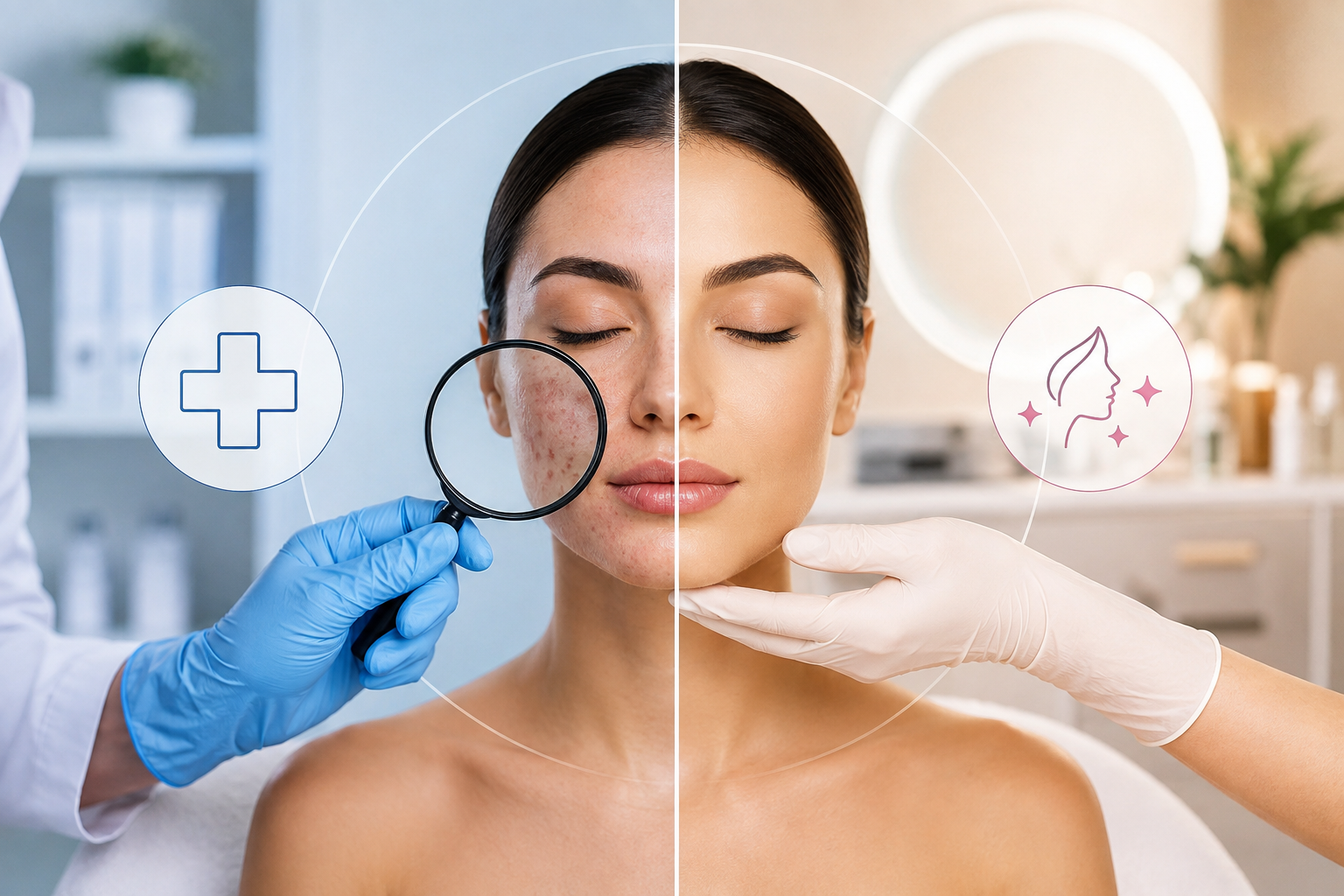
Skin concerns do not always fit neatly into either a medical or cosmetic category. Acne, pigmentation, scarring and other visible changes can affect appearance, but some may also be linked to an underlying skin condition that requires medical assessment.
This is where understanding the distinction between medical dermatology and cosmetic dermatology becomes useful. Both involve the skin and may sometimes use similar procedures, but their goals can differ. Medical dermatology primarily focuses on diagnosing and managing disease, while cosmetic dermatology generally addresses appearance-related concerns.
For patients, knowing where these areas overlap can help provide a clearer understanding of the role of a dermatologist and why an assessment may sometimes come before a cosmetic procedure.
Medical and Cosmetic Dermatology Have Different Primary Goals
The clearest difference between medical and cosmetic dermatology lies in the reason for care.
Medical dermatology focuses on conditions affecting the health and function of the skin, hair and nails. These may include inflammatory disorders, infections, hair and nail conditions and skin cancers.
Cosmetic dermatology, meanwhile, generally deals with concerns related to appearance. Patients may seek treatment for pigmentation, acne scars, uneven texture, visible signs of ageing or other aesthetic concerns.
The two areas should not necessarily be viewed as completely separate. A visible skin change may first need medical assessment before it can be appropriately considered from a cosmetic perspective.
| Medical Dermatology | Cosmetic Dermatology |
| Focuses primarily on skin disease and health | Focuses primarily on appearance-related concerns |
| May involve diagnosis and investigation | Usually begins by assessing the cosmetic concern and suitability for treatment |
| Includes inflammatory and infectious conditions | May address pigmentation, scars, texture and signs of ageing |
| May involve medication, phototherapy or procedures | May involve selected lasers, peels and other aesthetic procedures |
| Includes assessment and treatment of skin cancers | Generally involves elective treatment |
What Does Medical Dermatology Treat?
Medical dermatology covers a broad range of conditions involving the skin, scalp, hair and nails.
Examples include:
- Acne
- Eczema
- Psoriasis
- Rosacea
- Hives
- Skin infections
- Hair and scalp disorders
- Nail conditions
- Pigmentary disorders
- Skin allergies
- Suspicious moles and lesions
- Skin cancers
The approach depends on the condition being assessed. Some concerns can be diagnosed clinically, while others may require additional investigations such as skin sampling, allergy-related testing or a biopsy.
Treatment can also vary considerably. Depending on the diagnosis and severity, medical dermatology may involve topical medicines, oral treatments, injections, phototherapy or surgical procedures.
Chronic inflammatory diseases such as eczema and psoriasis may require ongoing management because symptoms can change over time. The treatment plan may therefore be adjusted according to disease activity, treatment response and individual circumstances.
Why a Skin Specialist May Work Across Both Areas
A skin specialist in Singapore may encounter both disease-related and appearance-related concerns because the appearance of the skin can be closely connected to its underlying health.
For example, someone seeking treatment for visible marks on the skin may first require assessment to determine whether the change represents pigmentation, scarring, inflammation or another dermatological condition.
This medical perspective can be particularly relevant when the diagnosis is uncertain.
A dermatologist can assess the skin concern, consider whether an underlying condition is present and discuss appropriate options based on the clinical findings. If the issue is primarily aesthetic, suitable cosmetic approaches may then be considered.
Medical and cosmetic dermatology can therefore meet at the point where skin health and appearance overlap.
What Does Cosmetic Dermatology Address?
Cosmetic dermatology generally focuses on changes that affect how the skin looks rather than treating disease alone.
Concerns may include:
- Acne scarring
- Uneven pigmentation
- Uneven skin texture
- Certain visible blood vessels
- Fine lines and other signs of ageing
- Selected benign skin growths
- Other appearance-related skin changes
The appropriate option depends on the type of concern, the patient’s skin characteristics and whether there are any underlying dermatological issues.
Cosmetic procedures may include selected laser treatments, chemical peels and other procedures performed according to the individual’s assessment and suitability.
In Singapore, clinical aesthetic procedures performed by doctors are regulated medical services. Doctors providing aesthetic procedures are expected to comply with the applicable Singapore Medical Council requirements and practise within their professional competence.
When Medical and Cosmetic Dermatology Overlap
The distinction between medical and cosmetic care becomes particularly clear when looking at individual skin concerns.
Acne and Acne Scarring
Active acne is primarily a medical dermatological condition.
Management may involve topical or oral treatments depending on factors such as the type and severity of acne. The immediate goal is to manage the active condition.
Acne scars, however, may remain after active inflammation has settled. Treatment aimed at improving the appearance of established scars can fall within cosmetic dermatology.
A patient may therefore move from medical management of active acne to cosmetic treatment of residual scarring at a later stage.
Pigmentation
Not every dark or light area of skin should automatically be considered a cosmetic pigmentation concern.
Changes in pigmentation can have different causes, including inflammatory skin conditions and pigmentary disorders. Assessment may therefore be useful when pigmentation is new, changing, extensive or associated with other symptoms.
Once the underlying cause has been assessed, appearance-related treatment may be considered where appropriate.
Skin Growths and Moles
Some skin growths are sought for removal because they are cosmetically bothersome. Others require assessment because of changes in size, shape, colour or other characteristics.
A dermatologist can assess the lesion before determining whether observation, biopsy, medical treatment or removal may be considered.
This is one reason why diagnosis and cosmetic treatment should not always be approached as separate processes.
Where Does Surgical Dermatology Fit?
Dermatology also includes a surgical component.
Surgical dermatology is generally used when a procedure is needed to diagnose or manage a skin condition. Examples may include:
- Skin biopsy
- Cyst removal
- Excision of selected skin lesions
- Treatment of selected skin cancers
- Cryotherapy for appropriate lesions
- Mohs micrographic surgery for selected skin cancers
A skin biopsy, for example, may be performed when microscopic examination of tissue is needed to help establish a diagnosis.
Skin cancer surgery is another area where dermatological assessment and surgical care meet.
Mohs Micrographic Surgery
Mohs micrographic surgery is a specialised surgical technique used for selected skin cancers.
During the procedure, tissue is removed in stages and examined microscopically so that areas containing remaining cancer cells can be identified. Further tissue is removed where required.
The technique may be considered for certain cancers where tissue conservation is particularly relevant, although it is not required for every skin cancer.
Whether Mohs surgery or another approach is appropriate depends on factors such as the cancer type, location, size and previous treatment history.
Where Does Phototherapy Fit?
Phototherapy is an example of a treatment used within medical dermatology rather than cosmetic dermatology.
It involves controlled exposure to specific wavelengths of ultraviolet light under medical supervision.
Depending on the individual’s condition and suitability, phototherapy may be considered for dermatological disorders such as:
- Eczema
- Psoriasis
- Vitiligo
- Selected other inflammatory or light-responsive skin conditions
Treatment schedules and the type of phototherapy used depend on the condition being treated and the patient’s clinical circumstances.
This illustrates an important distinction: although light- and laser-based technologies may both be associated with dermatology, their purposes can be very different. Phototherapy is used to manage selected medical skin conditions, while certain laser procedures may be used for appearance-related concerns.
Why Medical Assessment Can Matter Before Cosmetic Treatment
Sometimes a person already knows that their concern is cosmetic. In other situations, what appears to be an aesthetic issue may need further assessment.
Consider a newly appearing pigmented lesion. Treating its colour simply because it is cosmetically unwanted may not be the first consideration if the diagnosis has not been established.
Similarly, persistent redness may represent more than uneven skin tone. It may be associated with an inflammatory condition that requires medical management.
Assessment can help determine:
- What the skin change is likely to represent.
- Whether there is an underlying dermatological condition.
- Whether treatment is medically indicated, cosmetically motivated or involves elements of both.
- Which treatment options may be appropriate for the individual.
This diagnostic component is one of the main areas where a dermatologist’s medical training remains relevant even when a patient is primarily concerned about appearance.
How Can Patients Tell Which Type of Dermatology Care They Need?
The nature of the concern often provides the first indication.
Medical assessment may be considered when there is:
- Persistent itching, redness or inflammation
- A recurring rash
- Signs of skin infection
- Significant acne
- Hair or scalp changes
- Nail abnormalities
- A mole or lesion that has changed
- A wound or growth that does not appear to resolve
- A previously diagnosed chronic skin condition
Cosmetic care may be considered when the concern primarily involves:
- Established acne scars
- Uneven skin texture
- Appearance-related pigmentation
- Signs of ageing
- Other non-disease-related changes in appearance
There are also situations where patients may not know which category their concern falls into. Dermatological assessment can help clarify the nature of the problem before treatment options are discussed.
Medical and cosmetic dermatology have different primary purposes, but they are not always completely separate.
Medical dermatology focuses on diagnosing and managing conditions affecting skin health, while cosmetic dermatology generally addresses concerns related to appearance. Surgical dermatology may also form part of care when procedures are required for diagnosis or treatment.
In some situations, a condition begins as a medical problem and later leaves an appearance-related concern, such as acne followed by acne scarring. In others, a cosmetic concern may first need assessment to determine whether an underlying dermatological condition is present.
Understanding these differences can help patients have more informed discussions about whether their concern requires medical treatment, cosmetic care or an approach that considers both.
This article is for general information only and should not replace medical advice from a qualified healthcare professional.