

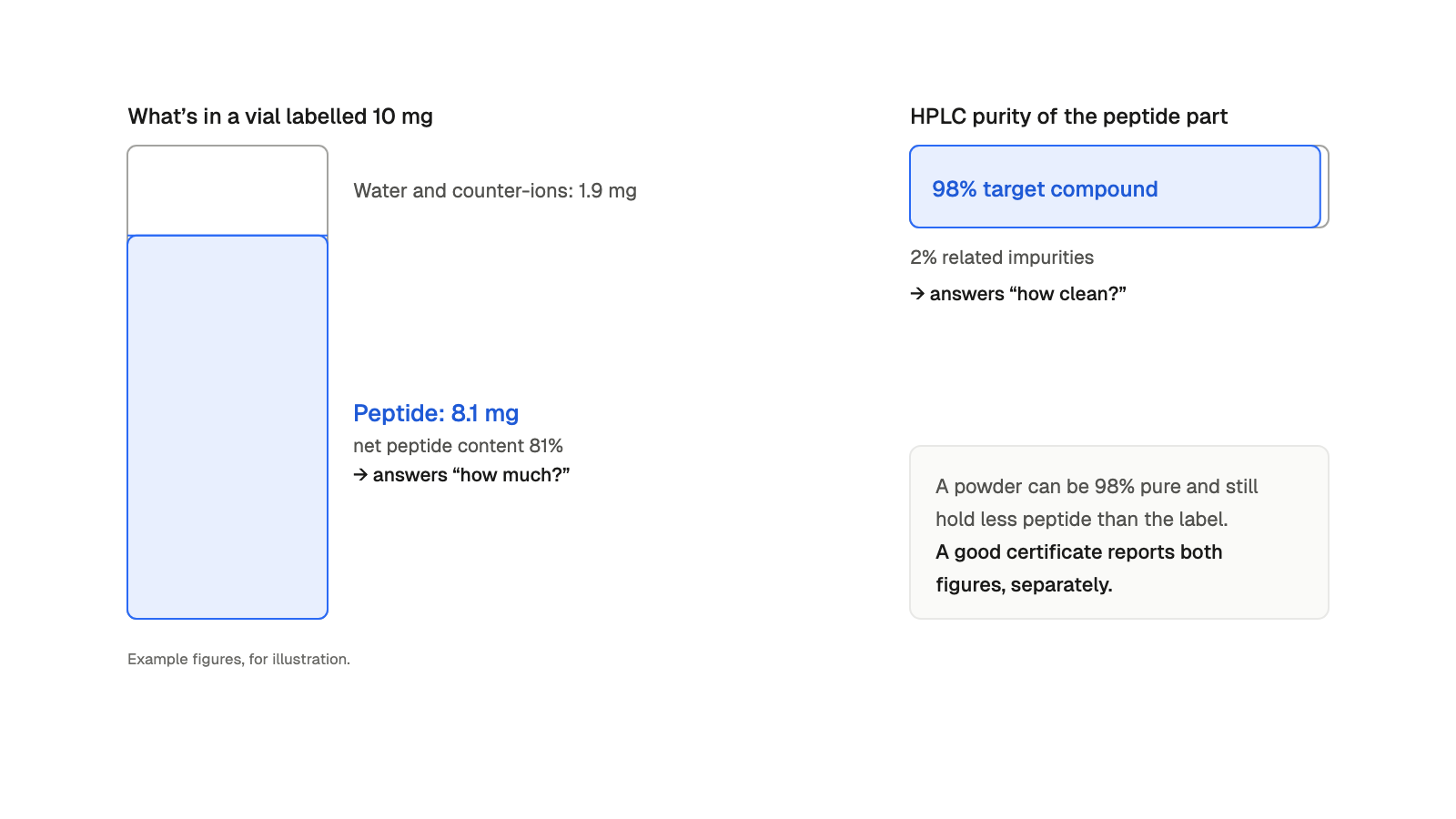
What’s in a vial labelled 10 mg: 8.1 mg peptide and 1.9 mg water and counter-ions, next to 98% HPLC purity
Anyone who reads protein powder labels knows the trick. A 30 g scoop is not 30 g of protein. Turn the tub around and the nutrition panel usually says something closer to 22 or 24 g, with the rest made up of moisture, carbohydrate, flavouring and minerals. Nobody is cheating; the scoop and the protein are simply two different numbers.
Laboratory peptides have the same gap, and it surprises people far more, because the vial is tiny and the label gives one figure. With many products, a vial marked “10 mg” holds 10 mg of powder. How much of that powder is the peptide itself is a separate question, and the answer is often somewhere between 60% and 90%.
Where the extra weight comes from
Research peptides are short chains of amino acids, built one link at a time by chemical synthesis and then purified. They are sold as a dry powder, and that powder carries two passengers.
Water. Peptide powders are hygroscopic, meaning they pull moisture out of the air. Even after freeze-drying, a few percent of the weight is usually water, and more if a vial has been opened in a humid room.
Counter-ions. Peptides carry electrically charged groups. Each charge is paired with an oppositely charged ion, much as sodium is paired with chloride in table salt. In most synthetic peptides that partner is trifluoroacetate, left over from the purification step. It isn’t part of the peptide chain, but it has weight, and that weight sits in the vial alongside the peptide.
Chemists call the peptide’s own share of that powder its net peptide content. It is a different measurement from purity, and the two are easy to confuse.
Purity and content answer different questions
Purity, usually measured by a technique called HPLC, looks only at the peptide part of the powder and asks how much of it is the right sequence rather than shortened or damaged copies. Net peptide content asks how much of the whole powder is peptide at all.
So a powder can be 98% pure and still hold only 8 mg of peptide in a “10 mg” vial, as the illustration above shows. Both numbers can be true at once, and both matter if you need to know how much material you are working with. Amidae’s library has a fuller explanation of net peptide content and purity, including how each one is measured.
Small molecules feel it most
The size of the peptide changes how big the gap is, because a counter-ion weighs the same whatever it is attached to.
Take the Epitalon tetrapeptide, a chain of just four amino acids (Ala-Glu-Asp-Gly) with a molecular weight of 390.35. Two of those four, glutamic acid and aspartic acid, are acidic. The chain has only one group that carries a positive charge in acid, the free amino group at its start, so it pairs with fewer counter-ions than peptides rich in lysine or arginine.
But the peptide is so light that even one counter-ion counts. A trifluoroacetate ion weighs about 113. If every Epitalon molecule carried one, the counter-ion alone would be about 22% of the salt’s weight, before any water is counted. A long peptide with the same single counter-ion would barely notice it.
That is why it helps when a supplier states plainly what the number on the label means. Amidae’s product page says the quantity on its label is the mass of peptide in the vial, not the weight of the powder, which is the figure most researchers actually want.
What to look for on a lab report
A certificate of analysis that takes quantity seriously will show at least one of these, alongside the purity figure:
- A net peptide content as a percentage, or a measured mass of peptide per vial.
- Water content, often measured by a method called Karl Fischer titration.
- The counter-ion, named, and sometimes measured.
If a report gives only purity, it has told you how clean the peptide is but not how much of it there is.
The takeaway
Like a scoop of protein powder, a vial of peptide holds more than its headline ingredient. The label weight, the peptide content and the purity are three different numbers. Knowing which one you are reading is the difference between a measurement you can trust and one that is quietly off by a fifth.
Amidae, which supplied the illustration, sells peptides strictly as laboratory research materials. They are not meant for people or animals.