

At first glance, the difference between tirzepatide and retatrutide seems almost too easy to explain.
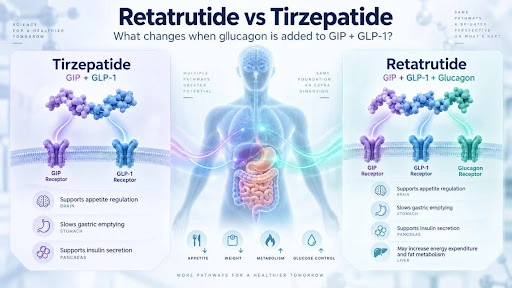
Tirzepatide acts on two receptors: GIP and GLP-1. Retatrutide targets those same two receptors and adds a third — the glucagon receptor.
The shorthand is simple:
Tirzepatide: GIP + GLP-1
Retatrutide: GIP + GLP-1 + glucagon
But that extra receptor matters more than the simple “two versus three” description suggests.
Tirzepatide helped establish the idea that two nutrient-responsive hormone pathways could be combined within a single molecule. Retatrutide takes that approach in a different direction by adding glucagon signaling, which reaches into aspects of metabolism that are not identical to the classic incretin story.
That is what makes the comparison interesting. The real question is not whether three targets automatically produce a bigger effect than two. It is what changes biologically when glucagon becomes part of the design.
From GLP-1 Alone to Dual Agonism
Before dual agonists moved into the spotlight, much of the attention in this area was centered on GLP-1 receptor signaling.
Compounds such as Semaglutide helped demonstrate how significant sustained GLP-1 receptor activation could be in metabolic research.
GLP-1 is involved in glucose-dependent insulin secretion, appetite regulation and gastrointestinal signaling. Its success made the pathway one of the defining targets of modern metabolic pharmacology.
But it also raised an obvious question.
If one nutrient-responsive hormone pathway could produce substantial metabolic effects, what might happen if another complementary pathway were engaged at the same time?
That question helped set the stage for tirzepatide.
Tirzepatide Showed What Dual Agonism Could Do
Tirzepatide combines activity at the GIP and GLP-1 receptors.
Both hormones are released in response to nutrients, and both participate in glucose-dependent insulin signaling. GLP-1 is also closely associated with appetite regulation and gastrointestinal signaling, while GIP has effects involving insulin response, nutrient handling and adipose tissue.
The important point is that tirzepatide did not simply reproduce GLP-1 receptor agonism in another form.
Its dual-receptor design broadened the model by allowing researchers to examine what happens when two related metabolic signals are coordinated within the same molecule.
The clinical results made that difficult to ignore.
In the Phase 3 SURMOUNT-1 trial, adults with obesity, or overweight plus at least one weight-related complication, were treated for 72 weeks.
Mean body-weight reductions were 15.0%, 19.5% and 20.9% across the 5 mg, 10 mg and 15 mg tirzepatide groups, compared with 3.1% with placebo.
Those findings helped move dual GIP/GLP-1 agonism from an interesting pharmacological idea into one of the central strategies in metabolic-drug research.
And once researchers had seen what two coordinated pathways could do, another question naturally followed:
Could a third pathway add something meaningfully different?
Retatrutide Adds Glucagon to the Equation
Retatrutide is built around activity at three receptors: GIP, GLP-1 and glucagon.
The first two components make the architecture somewhat familiar.
The third is where the comparison with tirzepatide becomes more interesting.
Glucagon is often introduced as the hormone that helps raise circulating glucose when the body needs more available fuel. That description is useful, but incomplete.
Glucagon signaling also plays a role in hepatic metabolism, substrate utilization and energy expenditure.
Researchers are therefore not simply taking a dual-incretin concept and adding another version of the same signal.
They are adding a pathway with a distinct metabolic role.
So What Might Glucagon Actually Change?
This is where the science becomes more interesting than the comparison headlines.
GLP-1 and GIP are both strongly connected to nutrient-responsive signaling. Glucagon introduces another layer involving how the body handles, mobilizes and uses energy.
A simplified way to think about the three pathways is:
GLP-1 signaling
Appetite regulation • glucose-dependent insulin secretion • gastrointestinal signaling
GIP signaling
Nutrient-responsive insulin signaling • metabolic effects involving adipose tissue
Glucagon signaling
Hepatic metabolism • substrate utilization • energy expenditure
These systems do not operate independently. They interact across multiple tissues and metabolic processes.
The appeal of triple agonism lies in the possibility that their effects can complement one another.
GLP-1 can influence food intake and glucose-dependent insulin secretion. GIP contributes to nutrient-responsive signaling and interacts with metabolic processes in adipose tissue. Glucagon introduces effects associated with hepatic energy metabolism and fuel utilization.
Put together, the idea is to influence several parts of energy balance at the same time rather than relying on one hormonal pathway in isolation.
But the balance matters.
Glucagon activity can also produce effects that need to be carefully controlled. The interesting part of the architecture is therefore not merely that a third receptor has been added, but how glucagon activity is balanced with the GIP and GLP-1 components within the same molecule.
The Receptor Map Is Simple. The Biology Isn’t.
The architecture itself is easy to visualize:
| Receptor Target | Tirzepatide | Retatrutide |
|---|---|---|
| GLP-1 receptor | Yes | Yes |
| GIP receptor | Yes | Yes |
| Glucagon receptor | No | Yes |
That table explains the design.
It does not automatically predict the outcome.
The number of receptors a molecule targets tells us surprisingly little on its own. Receptor potency, the balance between pathways, pharmacokinetics, dose, exposure and tolerability all matter.
A triple agonist is therefore not automatically more effective simply because three is a larger number than two.
What it provides is a different research model.
Tirzepatide asks what happens when GIP and GLP-1 signaling are combined.
Retatrutide asks what happens when glucagon activity is layered onto that same dual-incretin foundation.
Phase 2 Put the Triple-Agonist Idea on the Map
Retatrutide drew much wider attention after its Phase 2 obesity trial.
The randomized study evaluated several dose levels over 48 weeks.
At the highest studied dose, mean body-weight reduction reached 24.2% after 48 weeks, compared with 2.1% with placebo.
Another detail was particularly interesting: at the higher doses, participants were still losing weight when the study ended, suggesting that the weight-loss curve had not clearly reached a plateau.
The study could not tell researchers exactly how much of the observed effect came from GIP, GLP-1 or glucagon individually.
That is one of the challenges of studying a molecule designed to engage several pathways at once.
But the results provided a strong reason to take the triple-agonist strategy into larger Phase 3 trials.
From Phase 2 Signal to Phase 3 Expansion
That program has since moved considerably further.
In TRIUMPH-1, Lilly reported results from a Phase 3 trial evaluating retatrutide in adults with obesity or overweight and at least one weight-related comorbidity, without diabetes.
Participants receiving the 12 mg dose had an average 28.3% body-weight reduction at 80 weeks under the trial’s efficacy estimand.
Lilly also reported that 45.3% of participants in that group achieved at least 30% body-weight reduction.
Those findings are one reason Retatrutide has become such a prominent subject in next-generation metabolic research.
Placed side by side, SURMOUNT-1’s 20.9% figure at 72 weeks and TRIUMPH-1’s 28.3% figure at 80 weeks make an easy headline.
They do not make a head-to-head trial.
The studies were conducted separately. They ran for different lengths of time and involved different protocols, populations and study conditions.
Without a randomized trial directly comparing tirzepatide and retatrutide under the same conditions, those percentages should not be treated as proof that one molecule is inherently superior to the other.
The cleaner comparison is the receptor architecture.
Tirzepatide and Retatrutide Are Answering Different Questions
That may be the most useful way to think about the two molecules.
Tirzepatide was an important step because it tested what could happen when GIP and GLP-1 signaling were coordinated within one pharmacological structure.
Retatrutide keeps that dual-incretin foundation but introduces another dimension.
By adding glucagon receptor activity, researchers are investigating whether metabolic regulation can be influenced not only through appetite and nutrient-responsive signaling, but also through mechanisms more directly connected to hepatic metabolism, substrate utilization and energy expenditure.
That does not make retatrutide simply “the next tirzepatide.”
It makes it a different experiment.
More Targets Are Not Automatically Better
There is an obvious temptation to describe the development of these molecules as a straightforward progression:
One receptor. Then two. Then three.
It is a useful way to explain the history of the field, but it can also oversimplify what is happening.
Drug development is not a competition to accumulate receptor targets.
Adding another signaling pathway only becomes useful if the resulting balance produces a meaningful biological effect without introducing unacceptable trade-offs.
A molecule with strong activity at one receptor and modest activity at another may behave very differently from one with a different receptor balance, even when both technically target the same pathways.
The retatrutide story is therefore less about the number three and more about whether GIP, GLP-1 and glucagon can be coordinated effectively within one molecular structure.
Why a Direct Comparison Still Matters
The growing interest in “retatrutide vs tirzepatide” is understandable.
Both molecules engage GIP and GLP-1 receptors. Both have generated substantial clinical data. And both sit within the broader movement toward multi-receptor metabolic therapies.
But the glucagon component means retatrutide should not simply be viewed as a higher-powered version of the same idea.
Its design introduces a different metabolic variable.
That distinction matters because separate clinical trials can only tell us so much.
A true head-to-head study would allow researchers to evaluate the two molecules within the same population, over the same period and under the same study conditions.
Until then, mechanistic differences are easier to interpret than simple cross-trial percentage comparisons.
The Comparison Is Still Evolving
There is another major difference that sometimes disappears when tirzepatide and retatrutide are discussed side by side.
Tirzepatide is already an approved medicine for specific indications.
Retatrutide remains investigational.
As of September 2026, retatrutide has not been approved for public use, and its safety and efficacy continue to be evaluated through the clinical development process.
Its research program has also expanded beyond body-weight outcomes alone, reflecting wider interest in how triple agonism may affect interconnected metabolic and obesity-associated conditions.
That broader research may ultimately prove more informative than any single headline percentage.
Body weight is only one part of metabolic physiology.
Glucose regulation, insulin sensitivity, liver metabolism, adipose tissue, cardiovascular risk and other obesity-associated outcomes are closely connected.
A multi-receptor molecule gives researchers another way to investigate those connections.
The Real Difference Is What Glucagon Brings to the Design
The easiest way to describe tirzepatide and retatrutide is to say that one targets two receptors and the other targets three.
The more useful explanation is that retatrutide adds a different type of metabolic signal to an already established dual-incretin strategy.
Tirzepatide combines GIP and GLP-1.
Retatrutide keeps both of those pathways and adds glucagon.
That addition expands the research question from how the body responds to coordinated incretin signaling to whether those effects can be combined with another pathway involved in hepatic metabolism, fuel utilization and energy expenditure.
And that is ultimately why researchers are paying so much attention to the comparison.
Not because three automatically beats two.
But because adding glucagon changes the experiment.
Disclaimer: Tirzepatide is an approved medicine for specific indications. Retatrutide remains an investigational compound and is still being evaluated in clinical trials. This article is provided for educational and research purposes only.