

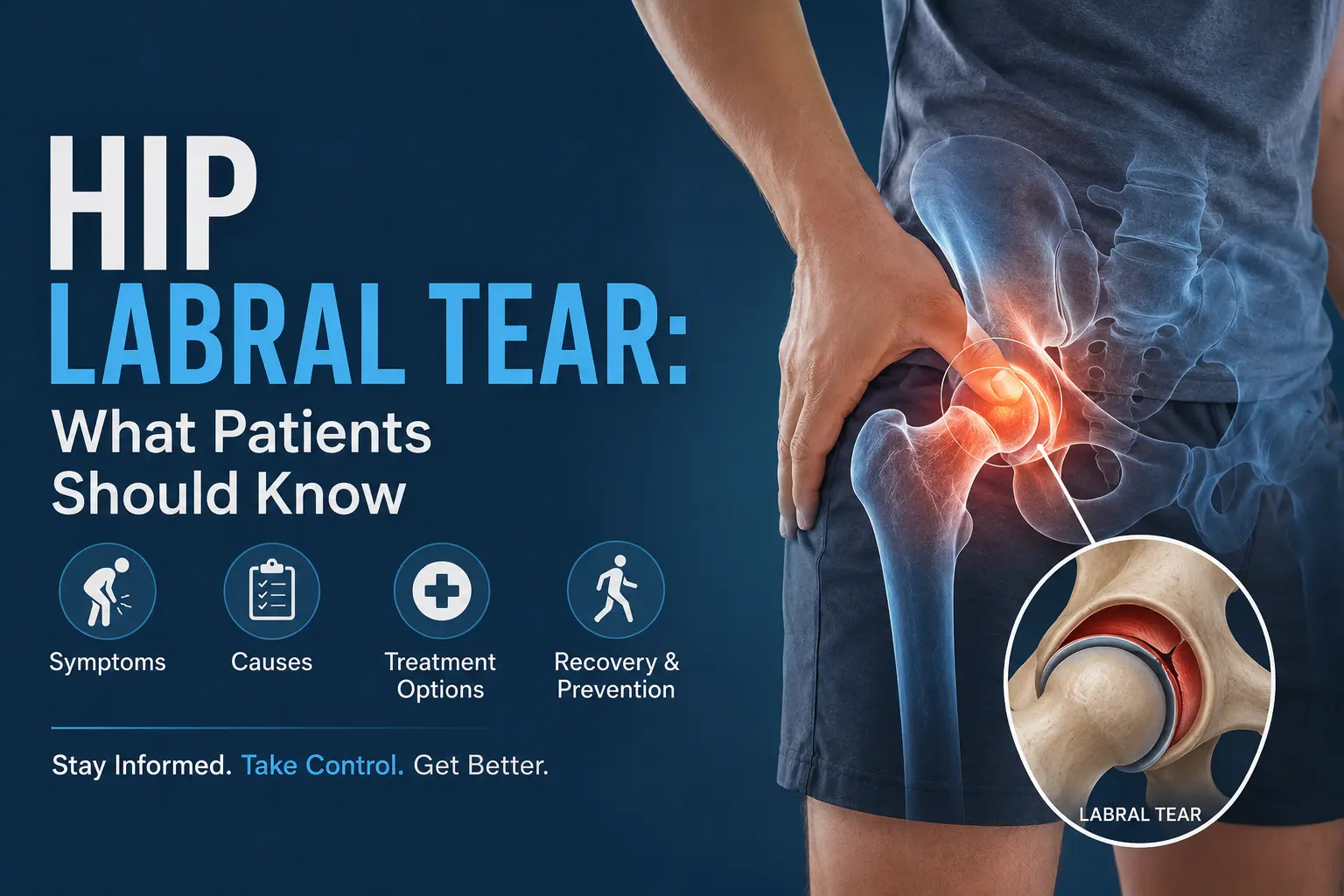
A hip labral tear is an injury to the labrum, the ring of cartilage that lines the socket of the hip joint. The labrum helps support smooth movement and stability of the hip by helping the ball of the thigh bone sit securely within the hip socket.
When the labrum is torn, patients may experience deep hip or groin pain, clicking, catching, stiffness, reduced range of motion, or discomfort during activities such as walking, running, twisting, squatting, or sitting for long periods. Some patients develop symptoms after a sports injury, while others may have gradual pain linked to repetitive movement or hip structure.
What Is a Hip Labral Tear?
The hip is a ball-and-socket joint. The ball is the head of the thigh bone, and the socket is part of the pelvis. The labrum is a ring of cartilage around the rim of the socket.
The labrum helps:
- Cushion the hip joint
- Improve joint stability
- Support smooth hip movement
- Help maintain a seal within the joint
- Reduce friction during movement
A hip labral tear occurs when this cartilage is damaged. The tear may happen suddenly after injury, or gradually due to repeated stress, abnormal hip shape, or wear and tear.
Common Symptoms of a Hip Labral Tear
Symptoms can vary. Some people have a labral tear on imaging but have little or no pain. Others may have symptoms that affect walking, exercise, work, or daily activities.
Common symptoms include:
- Deep pain in the hip or groin
- Pain at the front of the hip
- Clicking or catching sensation
- Locking sensation in the hip
- Hip stiffness
- Reduced range of motion
- Pain during twisting or pivoting
- Pain during squats or lunges
- Pain after prolonged sitting
- Pain during running or sports
- Feeling that the hip is unstable
- Pain that does not improve with rest
Pain from a hip labral tear is often felt in the groin, but some patients may feel pain at the side of the hip, buttock, or thigh.
Why Hip Labral Tears Can Be Difficult to Recognise
Hip labral tears can sometimes be difficult to identify because symptoms may overlap with other hip, groin, back, or pelvic conditions.
Similar symptoms may occur with:
- Hip impingement
- Hip osteoarthritis
- Hip flexor strain
- Tendon irritation
- Bursitis
- Groin strain
- Lower back-related nerve pain
- Sacroiliac joint pain
- Stress fracture
- Sports hernia
- Referred pain from nearby structures
This is why a proper assessment is important, especially when hip or groin pain is persistent, activity-related, or associated with clicking, catching, locking, or reduced movement.
What Causes a Hip Labral Tear?
A hip labral tear may develop for different reasons. In some patients, more than one factor may be involved.
1. Hip Impingement
Hip impingement, also called femoroacetabular impingement, occurs when the shape of the hip bones causes abnormal contact during movement. Over time, this may place stress on the labrum and cartilage.
Patients with hip impingement may notice pain during deep flexion movements such as squatting, sitting low, pivoting, or bringing the knee towards the chest.
2. Sports and Repetitive Movement
Sports that involve twisting, pivoting, kicking, jumping, or repeated hip flexion may place stress on the labrum.
Examples include:
- Football
- Dance
- Martial arts
- Gymnastics
- Hockey
- Rugby
- Running sports
- Golf
- Weightlifting
Athletes and active adults may develop symptoms gradually, especially if the hip is repeatedly loaded in positions that irritate the labrum.
3. Sudden Injury
A labral tear may occur after a fall, collision, twisting injury, road accident, or sudden force through the hip. Patients may remember a specific incident followed by pain, clicking, or difficulty returning to activity.
4. Hip Dysplasia or Structural Differences
Some people have hip anatomy that places extra stress on the labrum. Hip dysplasia, where the hip socket does not fully cover the ball of the joint, may increase stress on the labrum and surrounding structures.
5. Degenerative Joint Changes
In some patients, labral tears occur together with cartilage wear or hip osteoarthritis. In these cases, the labral tear may be part of a wider joint problem rather than an isolated injury.
Treatment decisions may differ when arthritis is also present.
When Should You See a Hip Specialist?
You may consider seeing a hip specialist or an orthopaedic specialist if hip or groin pain persists, keeps returning, or affects daily movement.
Medical review may be helpful if you have:
- Deep groin pain
- Hip pain during twisting or pivoting
- Hip clicking with pain
- Catching or locking sensation
- Pain that worsens with prolonged sitting
- Pain during sports or exercise
- Difficulty squatting or climbing stairs
- Reduced hip movement
- Hip pain after injury
- Symptoms that do not improve with rest or physiotherapy
- Pain that affects walking, sleep, work, or activity
Prompt review is advisable if there is severe pain after trauma, inability to bear weight, fever, sudden swelling, numbness, or symptoms after a fall or accident.
How Is a Hip Labral Tear Diagnosed?
Diagnosis usually begins with a medical history and physical examination. The hip specialist may ask when the pain started, where it is located, what movements trigger symptoms and whether there was an injury.
Assessment may include:
- Walking assessment
- Hip range of motion testing
- Pain location assessment
- Hip impingement tests
- Strength testing
- Review of sports or activity patterns
- Assessment of the lower back and pelvis where needed
- X-ray
- MRI scan
- MR arthrogram in selected cases
- Diagnostic injection in selected cases
A hip labral tear may not always be visible on standard imaging, and imaging findings should be interpreted together with symptoms and examination findings.
Why X-Rays May Be Done
X-rays do not show the labrum clearly, but they can help assess the bones of the hip joint. They may show structural issues such as hip impingement, dysplasia, arthritis, or other bone-related concerns.
This information can help the specialist understand why the labrum may be irritated and whether treatment should address the underlying hip structure.
MRI and MR Arthrogram
MRI can help assess soft tissues around the hip. In selected cases, an MR arthrogram may be recommended. This involves injecting contrast material into the hip joint before imaging to help show the labrum and joint structures more clearly.
The doctor will advise whether standard MRI or MR arthrogram is more suitable based on symptoms, examination and initial imaging findings.
Can a Hip Labral Tear Heal on Its Own?
The labrum has limited ability to heal on its own because its blood supply is limited. However, symptoms may improve with non-surgical treatment in some patients, especially if the tear is mild, the hip is stable and there is no significant structural problem or arthritis.
The goal of non-surgical care is usually to reduce pain, improve movement, strengthen supporting muscles and reduce activities that irritate the hip.
Non-Surgical Treatment Options
Non-surgical treatment may be recommended first, especially if symptoms are mild or moderate.
Options may include:
- Activity modification
- Avoiding painful twisting or deep hip flexion
- Physiotherapy
- Hip and core strengthening
- Mobility exercises
- Movement pattern correction
- Pain relief medication where suitable
- Anti-inflammatory medication where suitable
- Image-guided injection in selected cases
- Gradual return-to-sport programme
Non-surgical treatment may take time. Patients should follow the rehabilitation plan and return for review if symptoms do not improve.
Physiotherapy for Hip Labral Tears
Physiotherapy may help reduce symptoms by improving strength, control and movement around the hip and pelvis.
A rehabilitation programme may focus on:
- Hip muscle strength
- Core strength
- Gluteal strengthening
- Hip mobility
- Movement control
- Gait mechanics
- Avoiding painful positions
- Return-to-sport progression
- Load management
Patients should avoid forcing painful stretches or deep hip positions without guidance, as these may aggravate symptoms in some cases.
When Is Hip Arthroscopy Considered?
Hip arthroscopy is a minimally invasive procedure that uses small incisions, a camera and specialised instruments to assess and treat selected hip joint problems.
Surgery may be discussed if:
- Pain persists despite non-surgical treatment
- Mechanical symptoms such as catching or locking continue
- The tear is linked to treatable hip impingement
- Symptoms affect sport, work, or daily activities
- Imaging and examination support a labral tear diagnosis
- There is no advanced hip arthritis
- The patient understands the recovery and rehabilitation process
During hip arthroscopy, the surgeon may repair or trim the torn labrum and address contributing structural problems where suitable.
When Surgery May Not Be Suitable
Hip arthroscopy may not be suitable for every patient with a labral tear. If there is advanced hip arthritis or significant cartilage loss, repairing the labrum alone may not relieve symptoms effectively.
Other factors that may affect suitability include:
- Degree of joint damage
- Hip arthritis
- Hip dysplasia
- Bone shape
- Age and activity level
- Previous hip surgery
- Severity and duration of symptoms
- Response to non-surgical treatment
- Overall health
The orthopaedic specialist should explain whether arthroscopy, continued non-surgical care, or another treatment pathway is more appropriate.
Recovery After Hip Labral Tear Surgery
Recovery after hip arthroscopy varies depending on the procedure performed, tissue repaired and patient factors. Some patients may need crutches for a period, and physiotherapy is usually part of recovery.
Recovery may involve:
- Pain and swelling control
- Wound care
- Temporary use of crutches
- Restricted weight-bearing in selected cases
- Physiotherapy
- Gradual range of motion exercises
- Strengthening programme
- Return-to-work planning
- Return-to-sport progression
- Follow-up appointments
Patients should ask their surgeon when they can walk normally, drive, return to work, exercise and resume sports.
Returning to Sports and Exercise
Return to sports should be gradual. Even after minimally invasive surgery, the labrum and surrounding tissues need time to recover. Returning too soon may worsen symptoms or delay recovery.
Before returning to sport, patients should usually regain:
- Comfortable hip movement
- Good hip and core strength
- Pain control
- Balance and movement control
- Ability to perform sport-specific movements
- Confidence with pivoting, running, or cutting movements where relevant
A physiotherapist or orthopaedic specialist can guide progression based on the patient’s sport and recovery.
What Happens If a Hip Labral Tear Is Left Untreated?
Some labral tears may remain stable or improve symptomatically with non-surgical care. However, persistent tears linked to hip impingement or structural problems may continue to cause pain, catching, stiffness, or reduced function.
Ongoing symptoms may affect:
- Walking
- Sitting
- Squatting
- Sports performance
- Work duties
- Sleep
- Daily comfort
- Hip confidence during movement
Patients should seek review if symptoms persist or worsen despite rest and rehabilitation.
A hip labral tear is an injury to the cartilage ring around the hip socket. It may cause deep groin pain, hip clicking, catching, locking, stiffness, reduced range of motion and pain during twisting, pivoting, squatting, running, or prolonged sitting.
The condition may be linked to sports, sudden injury, repetitive hip movement, hip impingement, hip dysplasia, or degenerative joint changes. Diagnosis may involve physical examination, X-rays, MRI, MR arthrogram, or diagnostic injection where appropriate.
Treatment may include activity modification, physiotherapy, medication, injections, or hip arthroscopy in selected cases. Patients should seek orthopaedic review if hip or groin pain persists, affects activity, or is associated with mechanical symptoms such as clicking, catching, locking, or instability.
FAQ
What is a hip labral tear?
A hip labral tear is an injury to the labrum, the ring of cartilage that lines the socket of the hip joint and helps support smooth movement and stability.
What does a hip labral tear feel like?
It may cause deep hip or groin pain, clicking, catching, locking, stiffness, reduced movement, or pain during twisting, squatting, running, or prolonged sitting.
Can a hip labral tear heal without surgery?
Symptoms may improve with non-surgical care in some patients, including activity modification, physiotherapy and medication. However, the labrum has limited healing ability, and persistent symptoms may need further review.
How is a hip labral tear diagnosed?
Diagnosis may involve medical history, physical examination, X-rays, MRI, MR arthrogram, or diagnostic injection depending on symptoms and examination findings.
When is hip arthroscopy considered?
Hip arthroscopy may be considered if symptoms persist despite non-surgical treatment, mechanical symptoms continue, imaging supports a labral tear and the patient is suitable for surgery.
Is every hip labral tear painful?
No. Some people may have a labral tear on imaging without significant symptoms. Treatment decisions should be based on symptoms, examination findings, imaging and functional impact.
This article is for general information only and should not replace medical advice from a qualified healthcare professional.